Why the ounce figure alone misleads
Two jar candles can carry the same ounce figure and still behave very differently once lit. An ounce gives a weight-based size reference, not a complete description of a candle. It does not tell you the vessel's width, the wax depth, or the area that will liquefy around the wick. Jar depth and melt pool are different measurements. A tall, narrow jar and a low, wide bowl may look similar by weight while behaving differently as the wax melts.
Start with the melt pool. This is the area of wax that turns liquid around the wick. As a candle burns, the liquid wax should reach across more of the vessel rather than leaving a deep ring of solid wax at the sides. When the pool stays narrow, the wick has a smaller area of liquid wax to feed the flame, and tunneling can develop.
Tunneling is the familiar result: a hole down the center, with unused wax clinging to the walls. The ounce figure cannot tell you whether that will happen.
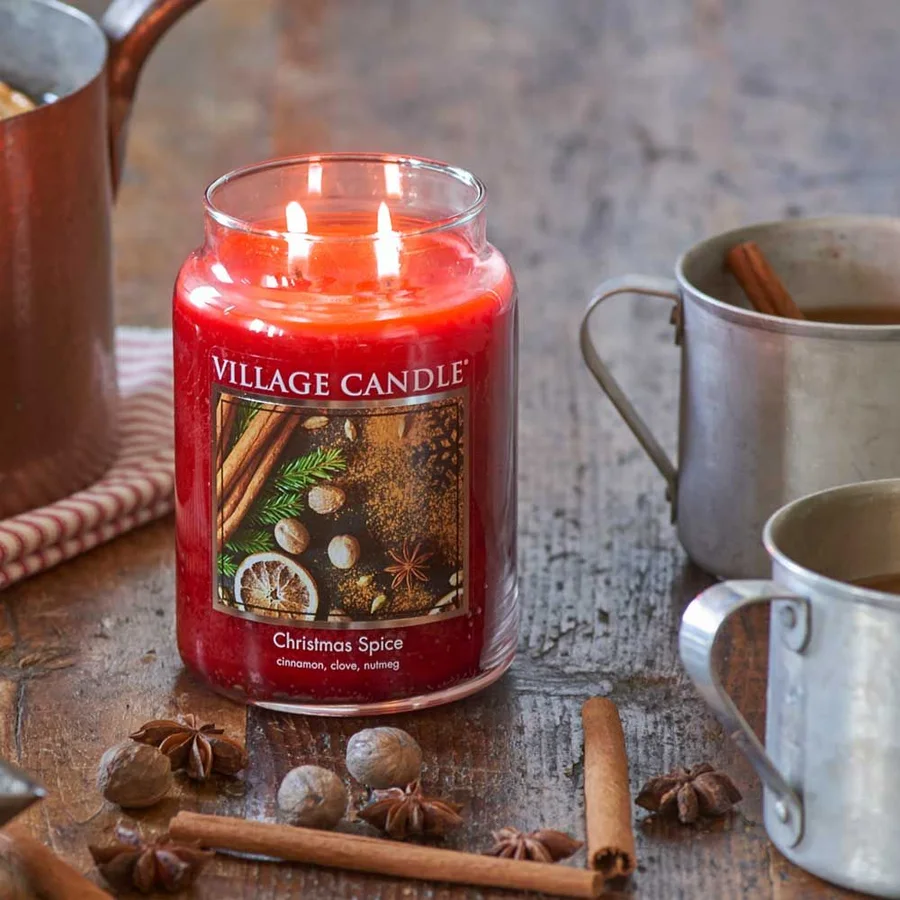
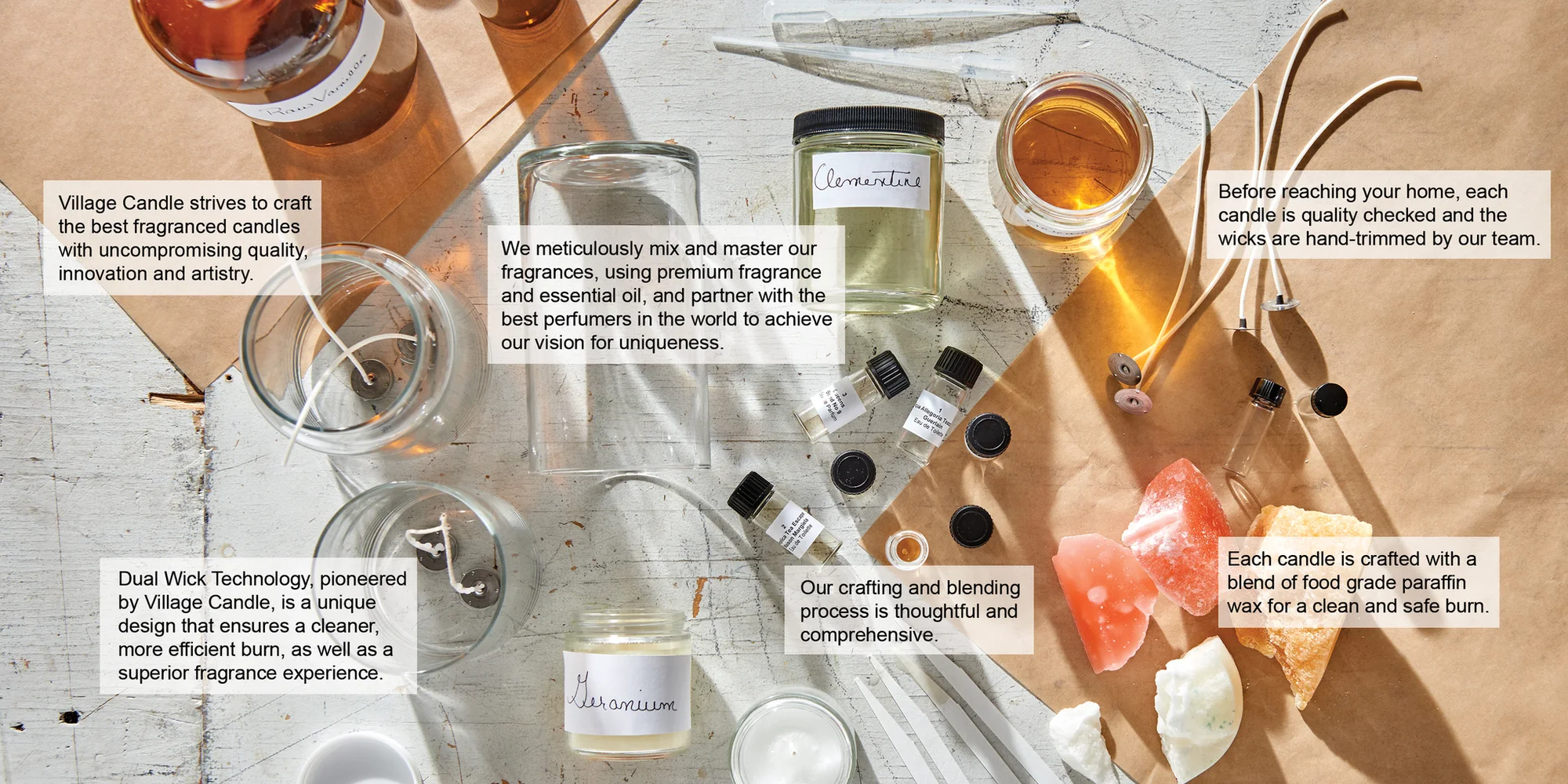
Dual Wick Technology came out of the Village Candle workshop. On 82 of the 152 pieces in the current range, two lead-free cotton wicks work together to create a broader, more even melt pool. Village Candle describes the result as a cleaner, more efficient burn. The wax is a soy wax blend in some lines and food-grade paraffin in others, depending on the line. These details matter because wick arrangement and wax composition cannot be reduced to ounces.
Those facts also put the burn-time figures in context. The current range includes 80 large jars, from 21.25 to 26 ounces, with burn times up to 170 hours. It also includes 62 medium jars and bowls from 11 to 19 ounces. The 170-hour figure is an upper limit, not a promise for every jar or every use.
A medium vessel contains less wax by weight, but its format can affect how the melt pool develops. Read ounces, container shape, wick information, wax type, and stated burn time together. There is no honest hours-per-ounce conversion from these facts alone.
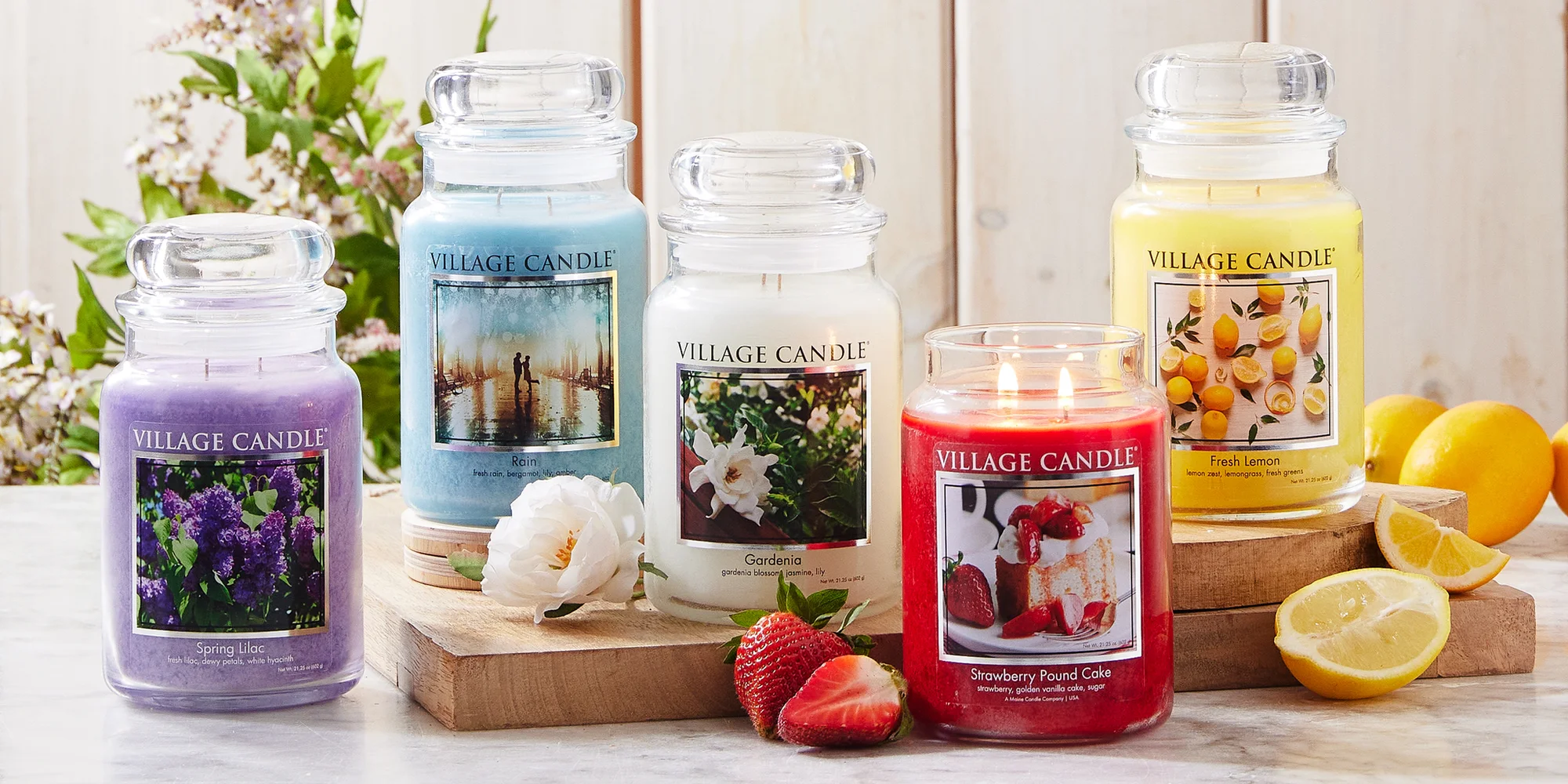
One wick, two or three
A jar candle's wick count is the easiest thing to spot on the label, and the hardest to judge without lighting it. Here is what each configuration actually does once the flame is on.
Single wick candles are the most familiar. One flame, one heat source, drawing wax up and outward from a single point. The melt pool grows in a slow circle. In tall, narrow vessels a single wick works well because the wax pool has less distance to travel to reach the glass.
In wider jars, a lone wick can struggle. The flame has to throw heat further across the surface, which sometimes leaves wax clinging to the sides and unused. That unused wax is the part most people notice when they trim the wick down and find a thick ring still sitting on the wall.
Two wicks, set apart, split the work. Each flame heats its half of the surface, so the wax pool tends to reach the edges sooner and behave more predictably from burn to burn. Village Candle pioneered this dual wick setup for their larger jars, and you will see it on most of the big 21 to 26 ounce formats.
The trade-off is small: each wick is thinner than the lone wick on a comparable single-wick candle, so trimming matters more. The payoff is a cleaner, more even burn across a wider top, which is exactly the geometry a big jar asks for.
Three wick candles appear less often in this collection, mostly on the widest vessels and bowls, where even two flames cannot bridge the gap alone. Three points of heat shorten the time it takes the melt pool to fully form and tend to keep the fragrance throw consistent across a long evening. The downside is shared with dual wicks: more wicks means more attention at every lighting.
The honest summary: wick count is a tool for matching the flame to the jar. Match the count to the diameter, trim every time, and the melt pool will take care of itself.
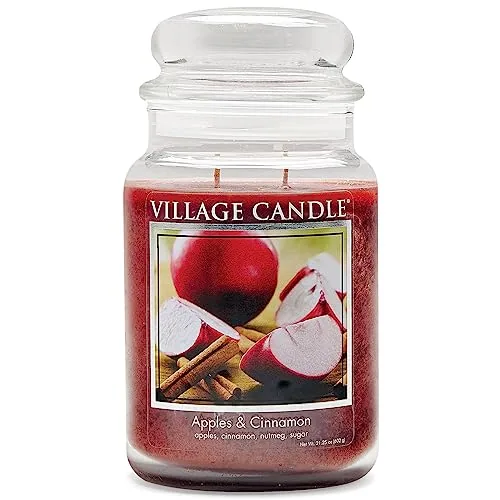
Trim the wick to ¼ inch before each use to prevent high flames and soot.
National Candle Association, Candle Safety Tips. Read 17 August 2026.
Burn time as arithmetic
Burn time gets quoted in hours, but the more useful number for some shoppers is hours per dollar. We have a wide range here. Prices run from $2.95 at the small end up to $212.40 at the top. Our largest jars are rated for up to 170 hours of burn. The arithmetic, in other words, can look very different depending on what lands in the cart.
Take a 26 ounce jar with the full 170 hour rating. At a typical jar price, you are looking at roughly four to five hours of burn for every dollar spent. That is a reasonable benchmark for a centerpiece candle you light on long evenings and slow weekends.
Medium jars in the 11 to 19 ounce range deliver fewer total hours, so their hours-per-dollar figure ends up in a similar neighborhood, sometimes a little higher, sometimes a little lower depending on size and price. At the low end of the catalog, where our wax melts and small formats sit, the per-dollar ratio looks generous because the entry price is so small. The trade is that you are paying for fragrance load and convenience alongside raw flame time.
Hours per dollar is honest as far as it goes, and it is a fair starting point if budget matters most. It also flattens a few things that matter. A dual wick jar pools faster and burns more cleanly across the whole surface, which is part of why we offer that format across many of our large jars.
A soy blend and a food-grade paraffin candle throw scent differently. And a tall centerpiece jar on a dining table is doing a different job than a small melt in a bedroom. The price covers more than raw burn hours.
The cleanest way to use this math is to start with how you actually light candles. A nightly ritual in one room favors a larger jar with a long burn. A guest dinner for ten favors a smaller, prettier piece that does its job in two hours and goes back in the drawer. Either choice can be the right one. The numbers help, but they should serve the use, not the other way around.
| Form | Pieces | Typical burn | Price span | Best hours per dollar |
|---|---|---|---|---|
| Large jars | 65 | 140-170 h | $17.71-$181.74 | 9.6 h/$ |
| Medium jars & bowls | 59 | 10-110 h | $12.95-$55.91 | 7.1 h/$ |
Matching the jar to the room
A large jar is built for open space. The 21.25 to 26 ounce format is sized to give a wide melt pool a chance to throw scent across a room with real air volume. The kind you find in a living room with a high ceiling, a kitchen that opens to a dining area, or a loft where one candle has to do the work of two.
With two lead-free cotton wicks working the surface, the wax clears evenly and the fragrance has room to travel. Burn times on this format run up to 170 hours, which is part of why it earns its keep in a room that gets daily use.
Medium jars and bowls, in the 11 to 19 ounce range, suit smaller enclosed rooms where a large candle would be working harder than it needs to. A bedroom, a home office, a reading nook, a powder room. A single wick is the common configuration in this tier, and the melt pool is sized to a footprint that makes sense at that scale. Scent throw stays pleasant rather than overwhelming, which matters in a space where you sleep or focus.
Wax melts belong in the smallest, most contained rooms, or for the moments when a flame is not the right answer. Bathrooms with the door shut, a hallway, a coat closet, the kind of space where lighting a jar feels like overkill. Because there is no flame, the fragrance comes from the warmer alone, and the scent lift is shorter and more local. Think of melts as a finishing touch rather than a primary source.
A practical way to think about it: match the candle to the cubic feet, not to the surface. Too small in a big room and the scent disappears. Too large in a small room and the fragrance overpowers before the wicks can settle into an even burn. The dual wick construction on the large format only delivers on its promise when the melt pool has somewhere to spread. Picking the right size up front is what makes the rest of the experience work.
| Room | Form we reach for | Pieces on sale |
|---|---|---|
| Open living room or kitchen | Large jar, dual wick | 66 |
| Bedroom or study | Medium jar or bowl | 68 |
| Closed or small spaces | Wax melt in a warmer, flame-free | 8 |
Soy blend or food-grade paraffin
Paraffin has been the workhorse of candle making for over a century. It's a refined wax that holds fragrance oils well and produces a consistent melt pool when paired with the right wick. In a dual-wick jar, food-grade paraffin tends to throw scent strongly and evenly across a room, which is one reason it remains a common choice for larger formats that need to fill more space.
Soy wax, by contrast, comes from hydrogenated soybean oil. It burns a bit cooler than paraffin and, on its own, can be softer and slower to throw fragrance. Most soy candles on the market are actually blends, mixing soy with paraffin or other waxes to get the best of both: cleaner burn characteristics from the plant-based side, scent strength and structure from the paraffin side.
In practice, the difference between a soy blend and a straight paraffin candle is subtler than the marketing suggests. Both waxes burn cleanly when the wick is trimmed properly and the jar is sized to the flame. Both are considered safe for indoor use. The honest split comes down to feel and finish: soy blends tend to have a slightly creamier color and a softer scent throw, while paraffin candles often carry fragrance a bit further and pool more uniformly across the top.
Village Candle uses both, and the choice depends on the line. Some scents are built around a soy blend for a softer, more natural character. Others lean on food-grade paraffin because the fragrance is fuller and more layered, and that wax carries it best. Either way, the wicks are lead-free cotton, hand-trimmed before the candle is shipped, and the burn is engineered around the wax rather than the other way around. The dual-wick setup is part of that tuning, matched to whichever wax the scent calls for.
The first burn sets the jar's memory
The first time you light a new candle, you are setting a pattern that follows it for the rest of its life. That pattern shows up as a ring of melted wax on the inside of the jar, the boundary between wax that has burned and wax that has not. Candle people call it the memory ring, and once it forms, the candle keeps reaching for it on every future burn.
Here is what is happening. A candle burns by drawing wax up through the wick. Heat pools in the center, so an unguided first burn leaves a tall column of solid wax down the middle and a narrow tunnel of melt. If you let that tunnel set, the next burn reproduces it, and the next.
By the third or fourth session the wick is sitting in a small crater of liquid wax surrounded by walls of unused fuel. The wick struggles to throw scent, and eventually the flame drowns in its own well.
The fix is patience on day one. Run the candle long enough for the melt pool to travel from wick to glass. For most jars in our range that means a first burn somewhere in the range of two to four hours, depending on size. The working rule is roughly one hour of burn time for every inch of jar diameter, with some variation by wax blend. Once that first edge-to-edge pool sets and cools, the candle remembers it. Every future burn reaches the same boundary.
Our dual-wick jars have an easier time of this than single-wick candles. Two flames heat the surface faster and more evenly, so the memory ring tends to form sooner, and to form cleanly all the way around. That is part of why dual wicks have become the format we lean on most often across the line.
After the first burn, trim the wick to about a quarter inch before the next session, and the candle will behave the way it was designed to.
Care: the quarter inch that decides
A Village Candle arrives with wicks already trimmed. Each one is hand-trimmed before it leaves, so the first lighting usually needs nothing more than a match or lighter. Between burns, a quick trim keeps the flame steady and the melt pool even. Most candle care guides suggest keeping wicks to roughly a quarter inch. For the dual wick jars, that means trimming both.
The first burn deserves a little attention too. A candle should be allowed to burn long enough for the wax to melt all the way to the edge of the jar, not just around the wicks. Skipping that step leaves a ring of solid wax the flame can never catch up to. From then on, the candle tunnels down the middle and the scent fades faster.
Trimming is best done with a small pair of wick trimmers, though scissors work in a pinch. The idea is to remove the charred tip from the previous burn rather than shorten an already short wick. A long or curved wick throws soot and smokes up the room, burning hot enough to scorch the wax. A short wick drowns in its own melt pool and tunnels down the center of the jar.
Draughts are the other thing worth paying attention to. A candle near an open window, a ceiling fan, or a heating vent will flicker and lean into the moving air. That pulls the melt pool to one side and wastes wax along the glass. You end up with a wall of unused fuel down the middle. A still surface, away from foot traffic and air currents, gives a cleaner burn.
The other habit that matters is knowing when to put the candle out. Standard guidance is to stop burning once roughly half an inch of wax remains at the bottom. Going lower risks overheating the container and leaves a layer of wax you cannot really use. Most of a Village Candle's life is well above the half-inch line, so the rule mostly just asks you to remember to stop in time.
Don’t burn candles all the way down—stop when ½ inch of wax remains.
National Candle Association, Candle Safety Tips. Read 17 August 2026.
What we would check before ordering
Start with where the candle will actually live. A large jar in the 21.25 to 26 oz range, with burn times up to 170 hours, is built for a living room or open-concept space where the candle runs often. A medium jar or bowl in the 11 to 19 oz range, with a shorter burn time, fits a bedroom, bathroom, or a smaller nook.
Burn time is only useful once you know the room. A small jar in a big space will not throw enough fragrance, and a large jar in a tight space will feel oversized for the room.
Wick configuration is the next thing worth checking. Village Candle's Dual Wick Technology shows up on 82 of the 152 pieces in the current range, and the two-wick setup is what gives those candles an even melt pool and a cleaner burn across the wider surface of the jar. Single-wick pieces work better in smaller formats. If you have a preference, the wick count is worth scanning for before you decide.
Wax is a smaller distinction but a real one. The range runs on food-grade paraffin for some lines and a soy wax blend for others, and both work with the lead-free cotton wicks, hand-trimmed by the brand. If your household has a preference for one base or the other, the product page states which is which.
Finally, group the scent family before you read individual notes. The current collection is sorted into seven: Holiday and Evergreen, Autumn and Spice, Bakery and Gourmand, Fruit and Orchard, Floral and Garden, Fresh and Coastal, and Woods and Signature. That narrows eighty fragrances down to a category quickly. Once you're on a specific candle, a last glance at the listed burn time and the weight in ounces tells you whether the price reflects the size you expected.